

Manufacturing businesses often have products, production capabilities and technical expertise that are difficult to explain through a simple website. Yet, when a potential buyer searches Google for a specific industrial product, component or manufacturer, the businesses that appear in relevant search results have an opportunity to enter that buyer’s consideration process.
This is where SEO for Manufacturers becomes important. A well-planned SEO strategy helps manufacturing companies improve their search visibility, make product information easier to discover and attract enquiries from distributors, procurement teams, wholesalers and other business buyers.
Unlike many consumer-focused websites, manufacturing websites need to communicate technical product details, manufacturing capabilities, applications and commercial requirements. Their SEO strategy must account for these differences.
This guide explains how manufacturers can build an effective B2B SEO strategy, optimize product catalogues, improve technical website performance and turn organic search traffic into relevant business enquiries.
Quick Answer: What Is SEO for Manufacturers?
SEO for manufacturers is the process of improving a manufacturing company’s website to increase its visibility in search engines, attract relevant B2B buyers and generate qualified business enquiries. It involves product and category page optimization, industrial keyword research, technical SEO, useful content and website improvements that help potential customers discover products, evaluate suppliers and request quotations.
Why Do Manufacturing Companies Need SEO?
Manufacturing businesses often depend on distributors, industry relationships, trade exhibitions, referrals and direct sales teams to acquire customers. These channels remain valuable, but they do not cover every potential buyer.
SEO for Manufacturing Companies helps industrial businesses improve their visibility in search results, reach relevant B2B buyers and generate enquiries for their products and services.
A procurement manager looking for an industrial component may start with a Google search. An engineering team may compare different suppliers before contacting a manufacturer. A distributor may search for companies that produce a particular product or offer specific manufacturing capabilities.
If a manufacturer’s website does not appear for relevant searches, potential buyers may discover competing businesses instead.
How industrial buyers use Google
The search behaviour of industrial buyers is usually more specific than general consumer searches.
For example, a buyer might search for:
- Industrial display rack manufacturer
- Commercial refrigeration compressor supplier
- Stainless steel fabrication company
- Custom sheet metal manufacturer
- Industrial equipment manufacturer
- OEM component supplier
These searches indicate different requirements. Some buyers are researching products, while others are looking for suppliers who can meet specific technical or commercial requirements.
A manufacturing website should provide useful pages for these different search needs.
How SEO supports the B2B buying process
The B2B buying journey often involves several stages:
- Product discovery: A buyer searches for a particular product, component or manufacturing solution.
- Research: They compare specifications, applications, materials and available options.
- Supplier evaluation: They review company experience, production capabilities, certifications and product information.
- Commercial enquiry: They contact shortlisted suppliers for pricing, availability or a quotation.
SEO can support each stage by making relevant website information discoverable.
For manufacturers, the objective should not be to attract the highest possible number of visitors. It should be to attract people whose requirements match the company’s products and capabilities.
Understanding Search Intent in the Manufacturing Industry
Before optimizing a manufacturing website, it is important to understand what potential buyers are actually looking for.
Not every search requires the same type of page. A product category page, technical guide and manufacturer profile serve different purposes.
An effective SEO strategy for the manufacturing industry starts with understanding how buyers search for products, compare suppliers and evaluate technical specifications before making purchasing decisions.
Industrial equipment manufacturers should optimize their websites around product specifications, equipment applications, technical capabilities and industry-specific requirements. Their SEO strategy should include detailed product pages, application-based content, technical documentation and clear enquiry pathways. This helps potential buyers evaluate equipment options and identify suitable manufacturing suppliers through organic search.
Product-based searches
These searches usually involve a particular product or product category.
Examples include:
- Supermarket display racks
- Industrial air compressors
- Stainless steel storage tanks
- Commercial refrigeration equipment
A dedicated product or category page is generally more appropriate for these searches than a general company blog.
Capability-based searches
Some buyers are not looking for a finished product. They are searching for a manufacturer with specific production capabilities.
Examples include:
- CNC machining services
- Custom metal fabrication
- Injection moulding manufacturers
- Precision engineering companies
Manufacturers should explain their capabilities, materials, processes, production capacity and applications through dedicated website sections.
Supplier and manufacturer searches
Buyers may also search directly for a manufacturer or supplier.
For example:
- Industrial rack manufacturer
- Compressor manufacturer
- Wholesale equipment supplier
- OEM manufacturing company
These searches have a stronger commercial context because the user is actively identifying potential suppliers.
Informational searches
Some buyers need technical information before making a purchase decision.
Examples include:
- How to choose an industrial compressor
- Types of supermarket display racks
- Difference between different steel grades
- Applications of industrial storage systems
Helpful educational content can introduce a manufacturer to potential buyers before they are ready to request a quotation.
The key is to match each search intent with the correct website page. Publishing multiple pages that target the same search intent can create unnecessary overlap.
Keyword Research Strategy for Manufacturers
Keyword research should always reflect the type of business and its website structure. A manufacturer selling physical products requires a different approach from a service-based business. Understanding the difference between service-based SEO and product-based SEO helps businesses create a more relevant keyword strategy and assign search terms to the right pages.
Product and category keyword research
Start by organizing the manufacturer’s complete product catalogue.
For each product category, identify:
- Main product name
- Common industry terminology
- Product variations
- Material or construction type
- Product applications
- Relevant technical attributes
For example, a display rack manufacturer may have separate categories for supermarket racks, grocery racks, wall-mounted displays and retail fixtures.
Each category can have its own relevant keyword group.
Technical specification keywords
Industrial buyers sometimes search using model numbers, dimensions, capacities, materials or technical specifications.
A compressor supplier, for example, may need to account for model numbers, capacity, phase, refrigerant and motor power in its product information.
These attributes should be included where they are accurate and useful to buyers.
Do not create separate thin pages for every minor specification variation simply to target more keywords. Build separate pages when the product or search intent genuinely requires them.
Industry and application keywords
Manufacturers should also consider how their products are used.
A company producing industrial storage systems might serve warehouses, supermarkets, retail stores and distribution facilities.
Application-specific searches can help connect the manufacturer’s products with the industries that need them.
Map keywords to website pages
A simple keyword mapping structure could look like this:
| Website page | Keyword focus |
|---|---|
| Homepage | Main manufacturing category and company positioning |
| Product category | Specific product category searches |
| Individual product page | Product name, model and relevant specifications |
| Capability page | Manufacturing processes and services |
| Industry page | Applications and industries served |
| Blog article | Informational and problem-solving searches |
This structure gives every important page a clear purpose.
Product and Category Page SEO for Manufacturing Websites
Product pages are among the most important parts of many manufacturing websites.
A website may receive impressions for a relevant industrial product search, but if the product page contains only a short description and a photograph, it may not provide enough information for either search engines or potential buyers.
Optimizing product category pages
A category page should explain what products are included, where they are used and what makes the manufacturer’s range relevant.
For example, a supermarket rack category page could include:
- Types of racks available
- Common applications
- Available configurations
- Materials and construction details
- Relevant product variations
- Links to individual products
Avoid making category pages into simple collections of product names. They should help visitors understand the product range.
Writing useful product descriptions
A good manufacturing product description should answer practical questions.
A buyer may want to know:
- What does the product do?
- What applications is it suitable for?
- What materials are used?
- What specifications are available?
- Can the product be customized?
- What should a buyer consider before requesting a quotation?
Product descriptions should be written around the actual product, not generated by changing a few words across hundreds of similar pages.
Product specifications and technical information
Technical information can be an important part of product-page quality.
Depending on the product, useful attributes may include:
| Product type | Relevant information |
|---|---|
| Industrial compressors | Model, capacity, phase and refrigerant |
| Display racks | Dimensions, material, configuration and application |
| Storage equipment | Load capacity, dimensions and construction |
| Machinery | Power, operating capacity and technical specifications |
Only publish specifications that have been verified by the manufacturer.
Internal linking across product catalogues
Product categories should link to relevant individual products. Individual product pages should also link back to their parent categories and related products where appropriate.
This helps visitors navigate large catalogues and gives search engines a clearer understanding of website structure.
Practical example — Era Display Solution
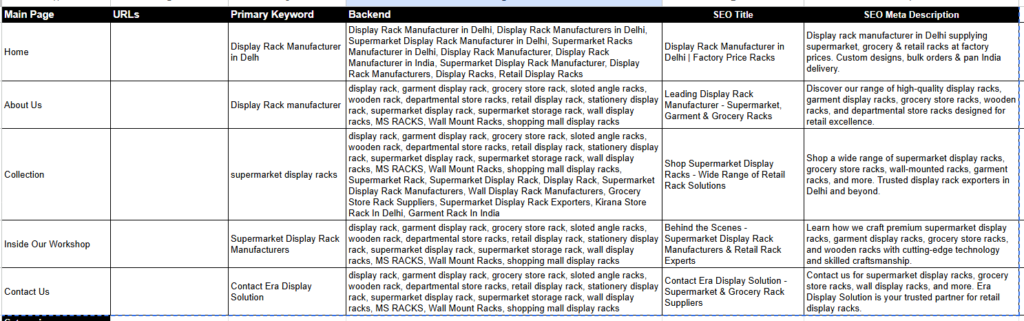
GPDM’s SEO work for Era Display Solution provides a relevant example of product and category-level optimization for a display rack manufacturer.
The website includes different display rack and retail fixture categories. Each category requires a clear keyword focus and relevant product information rather than relying on one broad homepage keyword.
The work involves product and category keyword mapping, product-page content optimization and improving how relevant pages connect within the website.
Example: Product Catalogue SEO for CompressorCR
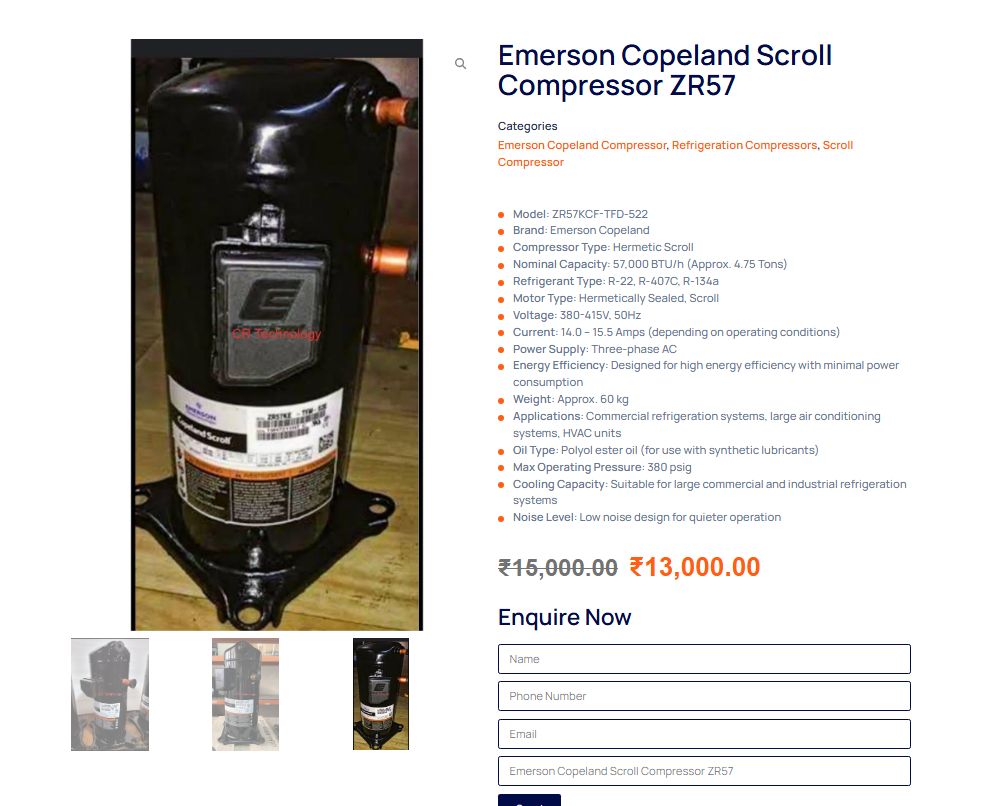
CompressorCR is an example of why detailed product information matters for manufacturing and industrial websites. Its catalogue includes multiple compressor products, each with specifications such as model number, capacity, phase, refrigerant, brand and motor power. Organising this information properly in product descriptions and category pages can help search engines understand individual products and help potential buyers find relevant specifications before making an enquiry.
Capability, Industry and Application Pages
Product pages alone may not explain everything a manufacturer offers.
Some businesses provide custom manufacturing, contract production, OEM services, specialized materials or solutions for multiple industries.
These requirements deserve dedicated website sections.
Why manufacturers need capability pages
A capability page explains what a manufacturer can produce and how it can meet a buyer’s requirements.
Depending on the business, it may include:
- Manufacturing processes
- Materials handled
- Production capabilities
- Customization options
- Quality control processes
- Industry experience
- Relevant certifications
For example, a metal fabrication company may need separate sections explaining laser cutting, CNC machining and sheet metal fabrication.
Each section should contain genuine information about the company’s capabilities.
Creating industry-specific pages
A manufacturer serving multiple sectors may benefit from pages explaining its products and applications for each industry.
Examples include:
- Manufacturing solutions for automotive businesses
- Industrial equipment for food processing facilities
- Storage systems for warehouses
- Display fixtures for retail businesses
These pages should offer industry-specific information, not simply duplicate the same product descriptions with different industry names.
Connecting products, capabilities and applications
A well-structured manufacturing website should make it easy for buyers to move between related information.
For example, a visitor researching a particular industrial product should be able to discover:
- The product category.
- Relevant product specifications.
- Manufacturing capabilities.
- Related applications.
- The company’s enquiry or quotation process.
This creates a more useful experience than treating every website page as an isolated SEO landing page.
Technical SEO for Manufacturing Websites
Manufacturing websites can have complex structures because of their product catalogues, product variations, downloadable catalogues and technical documentation.
Technical SEO helps search engines discover, crawl and understand important website pages.
Crawlability and indexation
Search engines need to access important product, category and capability pages.
Manufacturers should regularly check:
- Whether important pages can be crawled.
- Whether product pages are indexable.
- Whether XML sitemaps contain relevant URLs.
- Whether internal links lead to important pages.
- Whether discontinued products have appropriate URL handling.
Google Search Console can help identify indexing problems and show which pages receive impressions and clicks.
Managing duplicate product URLs
Large catalogues sometimes contain multiple URLs for similar products, filters or product variations.
If these URLs contain substantially similar content, they may create unnecessary duplication and make website management more difficult.
Use appropriate canonicalization and URL structures based on the actual page relationships. Do not automatically canonicalize every product variation to one page if the variations represent genuinely distinct products.
Website speed and mobile experience
Many industrial websites contain large product images, technical documents and complex page layouts.
Optimize images, reduce unnecessary scripts and maintain a responsive design.
A buyer should be able to view product information, navigate categories and submit an enquiry without struggling with the website on a mobile device.
Structured data for product pages
Where appropriate, manufacturers can use structured data to describe product information.
Google’s Product structured data documentation explains how eligible product pages can provide information such as product details, offers and availability.
An important distinction: Google’s product rich-result guidance is intended for pages focused on an individual product or its variants, not general product category listings.
Reference: Google Search Central — Product Structured Data
Structured data must accurately represent visible page content. Adding markup does not guarantee a rich result.
Content Marketing and Link Building for Manufacturers
Manufacturing businesses often have valuable technical knowledge that is not fully represented on their websites.
This knowledge can become useful content for potential buyers.
Technical blogs and buying guides
Useful manufacturing content can answer questions about:
- Product selection
- Material differences
- Industrial applications
- Maintenance considerations
- Technical specifications
- Common product problems
For example, a compressor manufacturer could publish a guide explaining the factors buyers should consider when selecting a compressor for a particular application.
A display rack manufacturer could explain the differences between different rack configurations and their retail applications.
The objective is to provide useful information that helps buyers make informed decisions.
Product comparison content
Comparison articles can address searches from buyers who are evaluating different products or solutions.
Examples include:
- Different types of industrial storage systems
- Types of commercial display racks
- Industrial compressor selection considerations
- Different manufacturing materials and their applications
These articles should be technically accurate and based on reliable product information.
Building relevant backlinks
Manufacturers should focus on obtaining links from sources that make sense for their industry.
Potential opportunities include:
- Relevant industrial directories
- Manufacturing associations
- Trade publications
- Industry partners
- Distributor websites
- Supplier relationships
- Relevant technical publications
The relevance and credibility of a link matter more than collecting large numbers of unrelated backlinks.
Avoid bulk link schemes and low-quality directories that offer no genuine industry value.
Local and International SEO for Manufacturers
Manufacturing companies may serve customers in their home market as well as overseas markets.
The website structure should reflect the actual markets, languages and products the business supports.
Local SEO for manufacturing businesses
Local SEO can be useful for manufacturers whose buyers search for suppliers within a particular location.
A manufacturer can improve local visibility by maintaining accurate business information, creating useful location information and ensuring its website clearly explains its products and capabilities.
However, local SEO is not equally important for every manufacturer. A company serving international buyers may need to prioritize broader product and capability searches instead.
International SEO for manufacturers
Manufacturers targeting overseas buyers should research how their potential customers search in each target market.
Product terminology, industry language and purchasing requirements may differ across markets.
For example, a product name commonly used in one market may have a different commercial term in another.
International keyword research should account for these differences rather than simply translating the same keyword list.
Multilingual and regional website structure
If a manufacturer offers genuinely localized pages for different languages or regions, it should use a clear URL structure and appropriate language or regional annotations.
Google recommends using separate URLs for language versions and hreflang annotations to identify alternate localized versions where applicable.
A single English-language page intended for a broad international audience does not need separate country versions simply because the company receives visitors from different countries.
Reference: Google Search Central — Managing International and Multilingual Sites
The right structure depends on the manufacturer’s actual markets, languages and business operations.
How to Generate Qualified B2B Enquiries Through SEO
Organic traffic is useful only when the website helps relevant visitors take the next step.
For manufacturers, that next step may be a product enquiry, technical discussion, sample request or Request for Quotation (RFQ).
Optimize quotation and enquiry forms
A manufacturing enquiry form should collect enough information to help the sales team understand the buyer’s requirement.
Depending on the business, useful fields may include:
- Name and company
- Business email
- Product or model requirement
- Required quantity
- Technical specifications
- Destination or delivery location
- Additional project details
Do not make forms unnecessarily complicated. Request the information that the sales team actually needs.
Use clear product enquiry CTAs
Generic buttons such as “Learn More” may not always communicate the next step clearly.
More relevant options include:
- Request a Quote
- Enquire About This Product
- Discuss Your Requirements
- Request Product Specifications
- Contact the Sales Team
The CTA should match the purpose of the page.
Make technical information accessible
Some buyers need to review product specifications before contacting a supplier.
Manufacturers can make useful resources available through:
- Downloadable product catalogues
- Technical datasheets
- Product brochures
- Installation guides
- Product comparison documents
These resources should be easy to find and should not replace important information that needs to be available directly on the product page.
Track enquiries, not just website traffic
Google Analytics 4 and appropriate conversion tracking can help manufacturers understand how visitors interact with their websites.
Track relevant actions such as:
- Enquiry form submissions
- Phone number clicks
- Email enquiries
- RFQ submissions
- Catalogue downloads
Where possible, connect website enquiries with the sales process to distinguish genuine business opportunities from irrelevant submissions.
A website receiving fewer but more relevant enquiries may be more valuable than one receiving large amounts of unrelated traffic.
How to Measure SEO Performance for Manufacturers
Manufacturing SEO should be measured through a combination of search visibility, website performance and business enquiries.
Google Search Console
Google Search Console helps manufacturers understand how their website appears in Google Search.
Important metrics include:
- Impressions
- Clicks
- Click-through rate
- Average position
- Search queries
- Page-level performance
- Indexing status
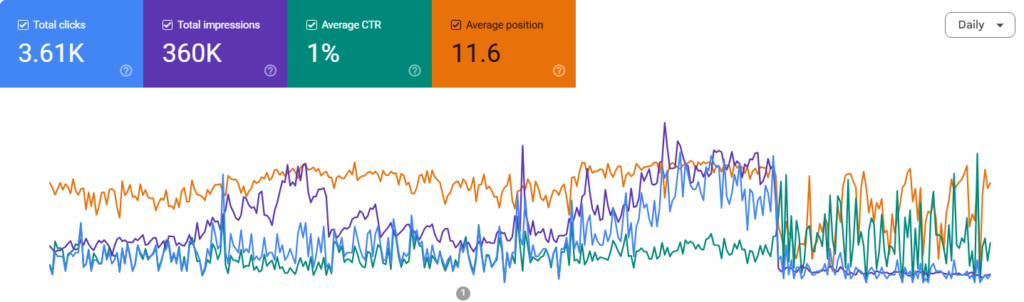
GSC Performance Screenshot
What Google Search Console Data Reveals
A practical example can be seen in the Google Search Console performance of Era Display Solutions. The website recorded 3.61K organic clicks and 360K impressions, with an average CTR of 1% and an average search position of 11.6 during the selected reporting period.
The search query report also highlights opportunities for improving product and category page visibility. For example, the query “display rack for shop” generated 4,924 impressions and 24 clicks, while “supermarket display racks” generated 2,600 impressions and 12 clicks.
These figures show why manufacturers should monitor individual product-related search queries rather than relying only on overall website traffic. Pages receiving impressions but relatively few clicks may need improvements in search intent alignment, page titles, meta descriptions and content relevance.
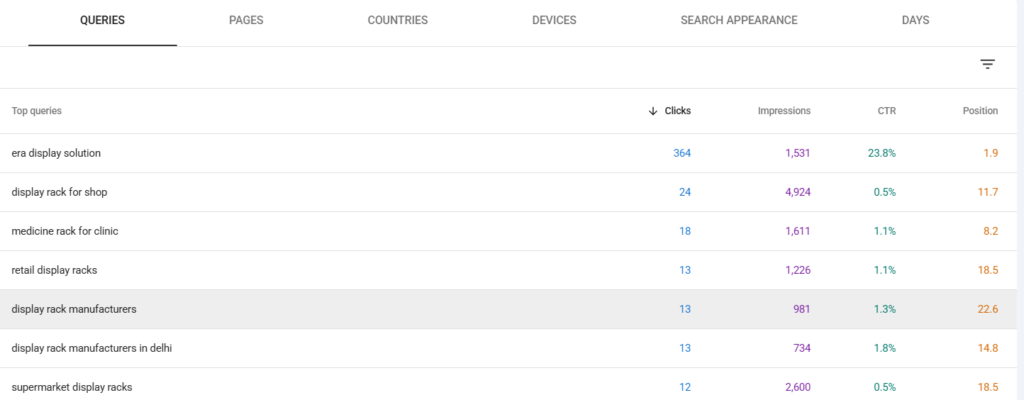
Review product and category pages separately to identify which parts of the catalogue are gaining visibility and which need improvement.
Measure product and category page performance
A manufacturing website may have hundreds of product pages, but not every page has the same commercial value.
Prioritize pages based on:
- Product importance
- Search demand
- Business profitability
- Search visibility
- Enquiry potential
- Content quality
This makes SEO work more focused and prevents resources from being distributed equally across pages that have very different business value.
Connect organic traffic with business enquiries
Use GA4 and conversion tracking to understand which landing pages contribute to enquiries.
Where possible, also record:
- Enquiry quality
- Relevant product interest
- Lead qualification status
- Quotation requests
- Sales outcomes
This helps management understand whether SEO is attracting the right audience.
Practical example — Era Display Solution
For a manufacturing website such as Era Display Solution, Search Console data can help identify which product and category pages receive search impressions, where clicks are limited and which keyword groups need further optimization.
The analysis should be performed at URL and query level rather than relying only on overall website traffic.
The purpose is to identify implementation priorities and connect organic search performance with the company’s business objectives.
How to Choose the Right Manufacturing SEO Agency
Manufacturing SEO involves more than writing blogs and adding keywords to a website.
An agency working with manufacturing businesses should understand product catalogues, technical information, category structures, industrial search intent and B2B enquiry journeys.
What experience should a manufacturing SEO agency have?
Before selecting an agency, manufacturers should evaluate whether it can:
- Understand product and category structures.
- Conduct industrial keyword research.
- Optimize technical product pages.
- Identify indexing and crawlability issues.
- Improve internal linking.
- Develop useful industry-specific content.
- Track qualified website enquiries.
An agency should also be able to explain how its SEO strategy connects with the manufacturer’s commercial objectives.
What should Manufacturing SEO Services include?
A practical service scope may include:
| SEO activity | Purpose |
|---|---|
| SEO audit | Identify website and technical issues |
| Keyword research | Understand industrial search demand |
| Product page optimization | Improve product-level visibility |
| Category page optimization | Strengthen product category relevance |
| Technical SEO | Improve crawling and indexing |
| Content strategy | Build useful industry-specific content |
| Link building | Develop relevant website authority |
| Conversion optimization | Improve enquiry pathways |
| Performance reporting | Measure search and business results |
The exact scope should depend on the website’s current condition, product catalogue and target markets.
Questions to ask before hiring an agency
- Have you worked with manufacturing or industrial websites?
- How will you approach product and category keyword mapping?
- How will you optimize a large product catalogue?
- How will you measure qualified B2B enquiries?
- What will your monthly reporting include?
- How will you handle technical SEO and indexing issues?
- How will you approach international search visibility?
A reliable agency should be able to explain its process, expected deliverables and measurement approach without promising guaranteed rankings.
How GPDM approaches manufacturing SEO
GPDM Agency works on SEO strategies that consider website structure, product information, keyword mapping, technical optimization and organic search performance.
Our work with manufacturing and industrial product websites, including Era Display Solution and CompressorCR, provides practical context for understanding the challenges associated with product catalogues and technical product pages.
Manufacturers looking for professional SEO support should work with an agency that understands product catalogues, technical website requirements and B2B search behaviour. Explore GPDM’s SEO services and optimization approach to understand how a structured SEO strategy can support your website’s organic visibility and business objectives.
Frequently Asked Questions About SEO for Manufacturers
What is SEO for manufacturers?
SEO for manufacturers is the process of improving a manufacturing company’s website so that its products, categories, capabilities and technical information can be discovered through relevant search queries.
It includes keyword research, product-page optimization, technical SEO, content development and conversion optimization.
How long does SEO take for manufacturing companies?
SEO timelines depend on the website’s current condition, competition, technical issues, content quality and target keywords.
A website with a strong technical foundation may progress differently from one with indexing problems, limited product information or a poorly organized catalogue.
Manufacturers should evaluate progress through search visibility, relevant organic traffic and qualified enquiries over time rather than expecting guaranteed rankings within a fixed period.
How much does manufacturing SEO cost?
Manufacturing SEO costs depend on the size of the product catalogue, website complexity, competition, number of target markets and amount of work required.
A small manufacturer with a limited catalogue may need a different scope from a company with hundreds of products and international operations.
A proper SEO audit is a better starting point than choosing a package based only on the number of keywords.
Can SEO help manufacturers generate international enquiries?
Yes. A manufacturer can use SEO to reach potential buyers searching for its products and capabilities in different markets.
However, international SEO requires relevant keyword research, accurate product information, suitable website structure and an enquiry process that supports overseas customers.
Search visibility alone does not guarantee international sales.
Which pages should manufacturers optimize first?
Start with the homepage, important product category pages, high-value individual product pages and capability pages.
Prioritize URLs according to business value, search demand, current visibility and the quality of their existing content.
Is SEO better than Google Ads for manufacturers?
SEO and Google Ads serve different purposes.
SEO can build long-term organic visibility, while Google Ads can provide paid visibility for selected searches when campaigns are properly configured.
Manufacturers can use both approaches depending on their budget, competition, product margins and lead-generation goals.
The right choice depends on the company’s commercial objectives and available resources.
What Is the Difference Between SEO for Manufacturers and Regular SEO?
SEO for manufacturers focuses on attracting business buyers, distributors, wholesalers, procurement managers and industrial customers rather than general consumers. Unlike regular SEO, which often targets broad consumer search terms, manufacturing SEO prioritizes product specifications, industrial applications, technical capabilities, bulk requirements and B2B search intent.
It also involves optimizing product catalogue pages, industry-specific landing pages, technical documentation and RFQ (Request for Quotation) pathways. The objective is not simply to increase website traffic but to attract relevant business enquiries and generate qualified leads that can turn into long-term commercial relationships.
How Do Manufacturers Generate Leads Through Organic Search?
Manufacturers generate leads through organic search by optimizing their websites for the products, specifications and industrial solutions that potential buyers actively search for. This involves targeting commercial keywords, creating detailed product pages, publishing application-specific content and improving visibility in relevant search results.
A well-optimized manufacturing website should also include clear enquiry forms, product catalogues, technical specifications, downloadable brochures and prominent contact options. When visitors find accurate product information and an easy way to request pricing or specifications, organic traffic has a better chance of converting into qualified B2B enquiries.
Which SEO Keywords Should Industrial Manufacturers Target?
Industrial manufacturers should target keywords based on their products, applications, industries, technical specifications and buyer requirements. Instead of focusing only on broad terms such as manufacturing company or industrial products, businesses should identify search queries that indicate a genuine purchasing or sourcing requirement.
Conclusion: Building Long-Term Organic Growth for Manufacturing Businesses
Manufacturing SEO requires a clear understanding of products, technical information, industrial search behaviour and the way B2B buyers evaluate suppliers.
A strong strategy should connect keyword research with product and category pages, improve website structure, make technical information accessible and create clear paths for potential buyers to request quotations.
Manufacturers should also measure the quality of enquiries generated through organic search rather than focusing only on rankings and website traffic.
For businesses planning to improve their search visibility, the first step is to understand what potential buyers are searching for and whether the existing website provides the information they need.
If your manufacturing business is looking to improve its search visibility, explore GPDM’s professional SEO services or contact our team to discuss an SEO strategy aligned with your products, target markets and business requirements.