

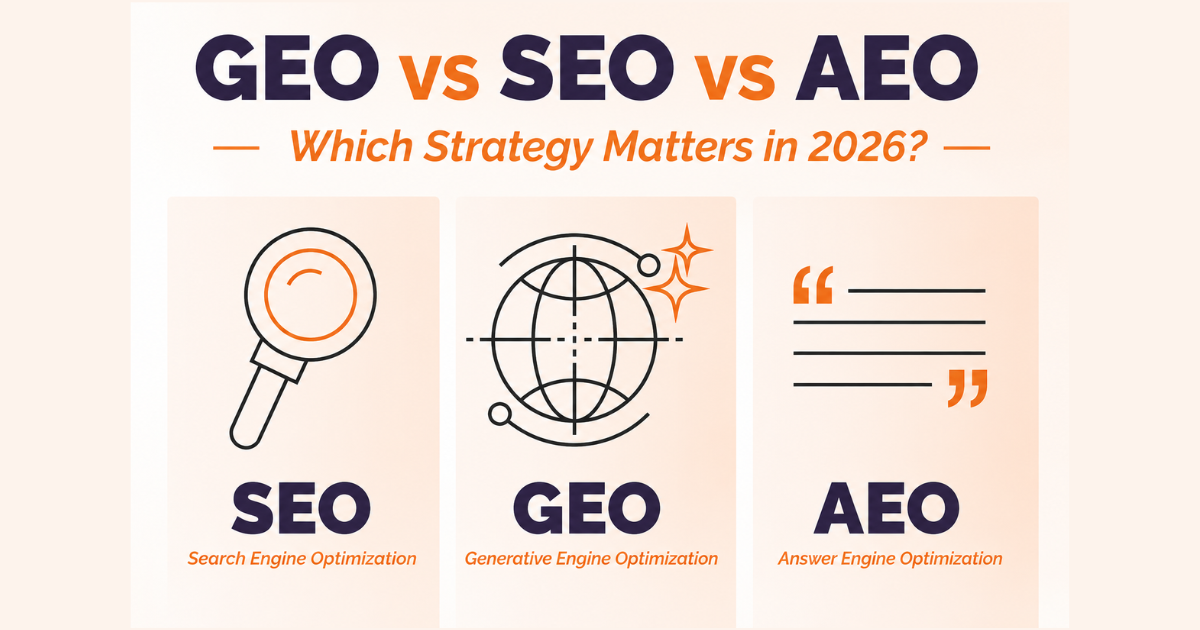
SEO, AEO and GEO are related but different approaches to search visibility. SEO focuses primarily on organic search rankings, AEO focuses on providing direct answers to user questions, and GEO focuses on making content understandable and retrievable in generative AI search experiences.
The three approaches overlap. A page can be optimized for traditional search while also being structured to answer questions clearly and provide useful context for AI-powered search systems.
The main difference is where and how the content is expected to be discovered.
If someone searches for:
SEO vs AEO vs GEO
they are usually trying to understand how these three approaches differ, whether they replace one another, and how they can be used together.
This guide explains those differences with practical examples.
Table of Contents
GEO vs SEO vs AEO: Quick Answer
SEO (Search Engine Optimization) focuses on improving a website’s visibility in traditional organic search results.
AEO (Answer Engine Optimization) focuses on structuring content so that clear answers can be identified and surfaced in answer-focused search experiences.
GEO (Generative Engine Optimization) focuses on improving how clearly a business, topic, or piece of content can be understood and potentially referenced within generative AI search experiences.
In simple terms:
| Optimization | Main focus | Typical outcome |
|---|---|---|
| SEO | Organic search visibility | Rankings and organic clicks |
| AEO | Direct answers | Answer-focused search visibility |
| GEO | Generative AI visibility | Potential inclusion or reference in AI-generated responses |
These aren’t three completely separate systems. They overlap because the same content can be useful for traditional search, direct-answer experiences and generative AI systems.
What Is Search Engine Optimisation (SEO)?
Search Engine Optimization (SEO) is the process of improving a website so that its pages can be discovered, understood and ranked in organic search results.
SEO can involve:
- Technical accessibility
- Search intent
- Content quality
- Internal linking
- Relevant backlinks
- Page structure
- Structured data where appropriate
- User experience
- Clear information architecture
For example, if a business wants to appear for:
digital marketing agency in Delhi
SEO would involve creating and optimizing a relevant page around that search intent while making sure Google can crawl, understand and evaluate the page.
Main SEO objective
Help relevant pages gain visibility in organic search and attract useful search traffic.
What Is Answer Engine Optimization (AEO)?
Answer Engine Optimization (AEO) is an approach to structuring content so that questions can be answered clearly and directly.
AEO commonly involves:
- Question-based headings
- Concise answers
- Clear definitions
- Lists and tables
- Logical content structure
- Relevant structured data where applicable
For example:
What is technical SEO?
Technical SEO is the process of improving the technical aspects of a website so search engines can crawl, understand and access its content effectively.
The answer appears immediately instead of forcing the reader to search through several paragraphs.
Main AEO objective
Make useful answers easy to identify, understand and retrieve.
What Is Generative Engine Optimization?
Generative Engine Optimization (GEO) is an approach to improving how clearly a website’s content, entities, expertise, and relationships can be understood by generative AI search systems.
Traditional SEO primarily focuses on visibility in organic search results. GEO focuses on how information may be discovered, interpreted, summarized, or referenced within generative search experiences.
GEO can involve:
- Clear and useful content
- Strong topical relevance
- Entity clarity
- Logical content structure
- Direct answers to relevant questions
- Consistent information about a business or organization
- Supporting evidence and sources
- Strong internal linking
For example, a page about AI SEO services should not simply mention the phrase “AI SEO.” It should explain what AI SEO means, what services are included, who the service is for, how it differs from traditional SEO, and what evidence supports the information.
This gives search systems more context about the topic and the entity behind the content.
Important: GEO should not be treated as a replacement for SEO. Google’s own documentation says its generative AI search features continue to rely on its existing Search ranking and quality systems, so fundamental SEO practices remain relevant.
For a deeper explanation, see our guide on What Is GEO Optimization?
Google also explains that its AI features in Search continue to use its existing Search ranking systems and SEO best practices. You can read Google’s guidance on optimizing for generative AI features in Search
If your goal is to improve visibility specifically in Google’s AI-generated search results, explore our complete guide on How to Rank in Google AI Overviews.
GEO vs SEO vs AEO: Key Differences
Although SEO, AEO, and GEO share the same ultimate goal of improving visibility, they work differently.
AEO vs SEO
AEO vs SEO mainly comes down to the type of search visibility being targeted. SEO focuses broadly on organic search visibility, while AEO focuses on making clear answers to specific questions easier to identify and surface.
GEO vs SEO
GEO vs SEO differs mainly in the search experience being considered. SEO focuses on organic search visibility, while GEO focuses on how information may be understood and potentially referenced in generative AI search experiences.
| Factor | SEO | AEO | GEO |
|---|---|---|---|
| Main focus | Organic search visibility | Clear answers to user questions | Generative AI search visibility |
| Content approach | Optimized content targeting relevant keywords and search intent | Direct, concise answers to specific questions | Clear, context-rich content that can be understood and referenced by AI systems |
| Typical goal | Improve rankings and organic traffic | Increase visibility in answer-based search results | Improve visibility in generative AI search experiences |
| Useful content formats | Landing pages, service pages, blogs, product pages | FAQs, definitions, how-to answers, concise explanations | Comprehensive guides, expert content, structured information, original insights |
| Important considerations | Search intent, technical SEO, backlinks, internal linking, content quality | Question relevance, answer clarity, structure, entities, schema | Context, authority, factual accuracy, entity understanding, citations and references |
| Can overlap with the others? | Yes | Yes | Yes |
The key difference
SEO is primarily concerned with organic search visibility.
AEO focuses on making answers easy to identify and surface.
GEO focuses on visibility and understanding within generative AI search experiences.
These approaches overlap rather than existing as completely separate systems.
When Should a Business Focus on SEO, AEO or GEO?
The appropriate focus depends on the type of visibility a business wants to improve.
A business focused on traditional Google search
SEO remains fundamental.
The focus may include:
- Search intent
- Technical SEO
- Content
- Internal links
- Authority
- Organic rankings
A business targeting question-based searches
AEO-style content structures can help make answers clearer and easier to find.
This may include:
- FAQ sections
- Question-based headings
- Direct answers
- Definitions
- Lists and tables
A business targeting AI-powered search
GEO becomes relevant when the goal is to make the organization’s information easier for generative systems to understand and potentially reference.
This requires more attention to:
- Entity clarity
- Topical relationships
- Consistent information
- Evidence
- Author and organization context
- Well-structured content
SEO vs AEO vs GEO: Practical Example
Imagine a digital marketing agency wants to attract customers searching for:
digital marketing agency in Delhi
SEO approach
The agency creates a dedicated service page optimized around the search intent.
The page explains:
- Services
- Location
- Industries served
- Process
- Pricing factors
- FAQs
- Contact options
The objective is organic search visibility.
AEO approach
The page adds clear answers to questions such as:
What does a digital marketing agency do?
How much does digital marketing cost in Delhi?
What services does a digital marketing agency provide?
Each question receives a concise answer before the detailed explanation.
GEO approach
The page provides additional context about the organization:
- Who the company is
- Where it operates
- What services it provides
- Who leads the organization
- Which industries it serves
- How its services work
- Relevant evidence and examples
- Related content explaining its expertise
The important point
The same page can use SEO, AEO and GEO principles at the same time.
They don’t necessarily require three separate pages.
GEO vs SEO vs AEO: What Does “Generative Engine Optimization” Mean?
Generative Engine Optimization (GEO) refers to the practice of improving how clearly a website’s content, entities, expertise, and relationships can be understood within generative AI search experiences.
The term is often discussed in relation to AI-powered search because these systems can generate responses using information retrieved from multiple sources.
For businesses, this means content should not simply contain keywords. It should clearly communicate:
- What the business is
- What it offers
- Who it serves
- Which topics it has expertise in
- How its information relates to other relevant topics
- What evidence supports its claims
GEO therefore overlaps with traditional SEO, but places greater emphasis on context, entities, relationships and information retrieval.
AI SEO vs Traditional SEO
AI SEO and traditional SEO share many fundamentals, but they can differ in the types of search experiences being considered.
Traditional SEO
Traditional SEO focuses heavily on:
- Organic rankings
- Search intent
- Technical accessibility
- Content quality
- Internal links
- Relevant authority signals
AI SEO
AI SEO considers those same fundamentals while also paying attention to:
- Entity clarity
- Context
- Topic relationships
- Direct answers
- Information structure
- AI-generated search experiences
The two approaches should not be treated as completely separate systems.
Google’s current documentation specifically states that its generative AI features continue to rely on existing Search ranking and quality systems, which means strong SEO fundamentals remain important.
How SEO, AEO and GEO Work Together
Think of them as three optimization layers:
SEO → Search visibility
AEO → Answer clarity
GEO → Generative search visibility
For example, one article can have:
- A strong SEO-focused title
- Clear search intent
- Question-based headings
- Concise answers
- Relevant internal links
- Structured information
- Clear author information
- Supporting evidence
- Strong topical context
This allows the content to serve both human readers and different types of search experiences without creating separate content for every platform.
Frequently Asked Questions
What is the difference between SEO, AEO and GEO?
SEO focuses on organic search visibility, AEO focuses on providing clear answers to user questions, and GEO focuses on improving how content and entities can be understood and potentially referenced in generative AI search experiences.
Is GEO the same as SEO?
No. GEO and SEO overlap, but they emphasize different search experiences. SEO primarily focuses on organic search visibility, while GEO focuses on visibility and information retrieval within generative AI experiences.
What is the difference between SEO and AEO?
SEO focuses broadly on organic search visibility. AEO places greater emphasis on answering specific questions clearly and structuring information so direct answers can be identified and surfaced.
What is Generative Engine Optimization?
Generative Engine Optimization, or GEO, is an approach to optimizing content and digital information for generative AI search experiences by improving context, entity clarity, topical relevance, structure and supporting evidence.
What is AEO in SEO?
AEO, or Answer Engine Optimization, can be considered an overlapping approach to SEO that focuses specifically on making useful answers clear, concise and easy for answer-oriented search experiences to identify.
Can SEO, AEO and GEO be used together?
Yes. A single page can be optimized for organic search while also providing direct answers and clear contextual information for AI-powered search systems.
Is GEO replacing SEO?
GEO should not be treated as a replacement for SEO. Traditional search remains an important discovery channel, while generative search adds another way users can discover information.
How can a website improve GEO?
Start with clear and useful content, strong topical context, consistent business information, clear entities, relevant internal linking, author and organization information, and evidence supporting important claims.
Conclusion
SEO, AEO and GEO are not simply three competing versions of search optimization.
They address different parts of the modern search experience.
SEO focuses on organic search visibility.
AEO focuses on clear, answer-oriented content.
GEO focuses on helping generative AI systems understand and potentially reference useful information.
For most websites, the practical approach is not to create three completely separate content strategies.
Instead, build useful pages with:
- Clear search intent
- Strong topical coverage
- Direct answers
- Logical structure
- Internal links
- Reliable information
- Clear business and author context
Then measure how those pages perform across the search experiences that matter to the business.