

Generative Engine Optimization (GEO) is a modern optimization strategy that helps websites and content get discovered, cited, and recommended by AI-driven search platforms. It ensures that content is structured, authoritative, and contextually relevant so that AI systems can use it in their generated answers.
Generative Engine Optimization (GEO) is the process of optimizing content and websites for AI-driven search systems. Instead of focusing only on rankings in traditional search results, GEO focuses on improving visibility inside AI-generated answers, citations, summaries, and recommendations.
As AI search continues to grow in 2026, businesses that ignore AI SEO and GEO Optimization risk losing visibility, organic traffic, and future search relevance.
Table of Contents
What is GEO Optimization?
GEO Optimization stands for Generative Engine Optimization. It refers to the process of optimizing digital content for AI-powered search engines and answer engines.
Unlike traditional SEO, which focuses mainly on search rankings and clicks, GEO focuses on:
- AI citations
- entity trust
- semantic understanding
- answer visibility
- retrievable content structure
Modern AI systems no longer rely only on keywords. They analyze:
- topic depth
- contextual relevance
- structured information
- authority signals
- relationships between entities
This is why many websites with strong traditional SEO are still failing to appear in AI-generated answers.
While GEO focuses on improving visibility across AI-powered search platforms, Google’s AI Overviews have their own optimization best practices. Learn How to Rank in Google AI Overviews to understand the strategies that increase your chances of appearing in AI-generated search results.
How GEO Optimization Works
AI search engines work differently from traditional search engines.
Instead of only displaying blue links, AI systems generate summarized answers by collecting information from multiple trusted sources.
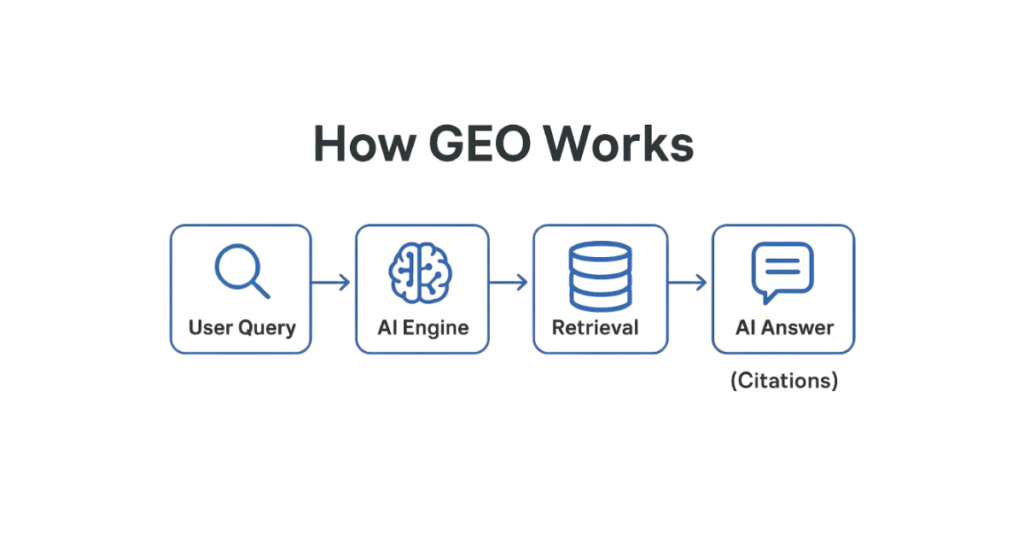
Platforms using AI-driven search include:
- Google AI Overview
- ChatGPT
- Gemini
- Perplexity
These systems evaluate:
- semantic relevance
- content clarity
- structured formatting
- expertise signals
- topical authority
- trustworthiness
For example, a website with:
- well-structured answers
- clear topic coverage
- FAQ sections
- comparison tables
- schema markup
- strong internal linking
has a higher chance of being referenced inside AI-generated results.
If your primary goal is to appear in Google’s AI-generated answers, read our detailed guide on How to Rank in Google AI Overviews, where we explain semantic SEO, E-E-A-T, structured data, and topical authority in depth.
GEO vs SEO vs AEO
Many businesses confuse SEO, AEO, and GEO. While all three are connected, their goals are different.
| Traditional SEO | AEO | GEO |
|---|---|---|
| Focuses on rankings | Focuses on answers | Focuses on AI visibility |
| Targets search engines | Targets answer engines | Targets AI systems |
| Keyword optimization | Question optimization | Entity optimization |
| SERP traffic | Featured snippets | AI citations |
| Clicks | Direct answers | Brand mentions |
Traditional SEO is still important, but AI SEO and GEO Optimization are becoming essential as AI-generated search continues to expand. While GEO focuses on AI-generated search visibility, it works alongside traditional SEO and AEO strategies. To understand how these approaches differ and complement each other, read our detailed guide on GEO vs SEO vs AEO.
Why GEO Optimization Matters in 2026
AI search is reducing traditional organic clicks faster than many businesses expected.
Google AI Overview now answers many user queries directly inside search results. Users often get answers without visiting websites.
This creates a major challenge:
- Fewer clicks
- Lower organic CTR
- Higher competition for visibility
Businesses now need visibility not only in rankings but also inside AI-generated answers. Google has already started expanding AI-generated search experiences through AI Overviews, changing how users discover information online.
This is where GEO Optimization becomes important.
Websites optimized for AI search can:
- improve brand authority
- increase AI citations
- appear in AI-generated summaries
- build topical trust
- gain visibility across multiple AI platforms
Businesses relying only on traditional keyword SEO may struggle as AI search continues to evolve.
How AI Search Engines Find Information
AI systems do not “think” like humans. They retrieve information based on patterns, trust signals, semantic relevance, and structured data.
AI search engines analyze:
- headings
- contextual relationships
- internal links
- semantic entities
- content structure
- author authority
- schema markup
This is why poorly structured AI-generated content often fails to gain AI citations.
For example, concise definitions like this are easier for AI systems to retrieve:
GEO (Generative Engine Optimization) is the process of improving website visibility in AI-powered search systems such as Google AI Overview, ChatGPT, Gemini, and Perplexity.
AI systems also prefer:
- concise paragraphs
- direct answers
- comparison tables
- question-based headings
- structured formatting
How to Optimize Websites for GEO
Businesses looking to improve AI search optimization should focus on both traditional SEO and modern GEO strategies.
1. Build Topical Authority
Instead of publishing random blogs, create topic clusters around a specific subject.
For example:
- GEO Optimization
- AI SEO
- AI Overview
- semantic SEO
- entity SEO
This helps search engines understand subject expertise.
2. Use Structured Content
AI systems prefer content that is:
- easy to scan
- semantically clear
- logically structured
Use:
- H2 headings
- tables
- bullet points
- FAQs
- concise explanations
3. Improve Internal Linking
Internal linking helps search engines understand relationships between topics. Businesses looking to improve AI visibility should focus on structured content, semantic SEO, and professional AI SEO Services that align with modern search behavior.
4. Add Schema Markup
Schema helps AI systems understand:
- Authors
- Organizations
- FAQs
- services
- entities
Important schema types:
- Organization
- FAQ
- Article
- Breadcrumb
- Author
5. Publish Original Insights
Most AI-generated blogs fail because they repeat existing information without adding anything useful.
Original insights, observations, and research improve:
- Trust
- Authority
- Citation probability
Common GEO Optimization Mistakes
Many businesses are already making mistakes while trying to optimize for AI search.
Common mistakes include:
- keyword stuffing
- generic AI-generated content
- weak internal linking
- no entity consistency
- no semantic structure
- publishing random blogs
- ignoring topical authority
- poor content formatting
AI systems increasingly prioritize clarity and trust over keyword repetition.
Future of SEO After AI Search
SEO is not dying, but it is changing rapidly.
Future search visibility will depend on:
- entity authority
- semantic trust
- AI readability
- topical expertise
- content structure
- retrievable information blocks
Businesses that adapt early to GEO Optimization and AI SEO will likely gain a strong competitive advantage over the next few years.
The future of search will not only belong to websites ranking on Google, but also to brands consistently referenced inside AI-generated answers.
Frequently Asked Questions
What is GEO Optimization?
GEO Optimization is the process of optimizing websites and content for AI-driven search systems such as Google AI Overview, ChatGPT, Gemini, and Perplexity.
Is GEO replacing SEO?
You can also explore our detailed comparison of GEO vs SEO vs AEO to understand how these optimization strategies work together.
What is the difference between GEO and SEO?
SEO focuses on search rankings and traffic, while GEO focuses on AI visibility, citations, and semantic trust.
Can websites appear in ChatGPT answers?
Yes. Websites with strong authority, structured content, semantic relevance, and trustworthy information may appear in AI-generated responses.
Why is AI SEO important in 2026?
AI-generated search results are increasing rapidly, reducing traditional clicks and changing how users discover information online.
Conclusion
The rise of AI-driven search is transforming how businesses gain online visibility. Traditional SEO alone is no longer enough for long-term digital growth.
Businesses looking to prepare for the future of search should understand the relationship between SEO, AEO, and GEO. Our guide on GEO vs SEO vs AEO explains how each strategy contributes to modern search visibility.
As platforms like Google AI Overview, ChatGPT, Gemini, and Perplexity continue to evolve, websites optimized for AI readability, topical authority, and structured information will gain a significant advantage.
About the Author
Manish Mishra is the Founder of GPDM Agency and specializes in SEO, AI SEO, GEO Optimization, Local SEO, and digital marketing strategies for businesses looking to improve their online visibility and lead generation.
Want to improve your visibility in Google AI Overview and AI-powered search systems?
Explore our AI SEO Services and SEO Services in Delhi to build stronger authority, improve rankings, and increase AI search visibility.